0
Reach Truck vs VNA Truck: Which Works Better for High-Density Warehousing?
Key Takeaways:
- Reach trucks balance narrow-aisle operation with the flexibility to move between different warehouse areas.
- A VNA forklift can reduce aisle space further, allowing more of the warehouse footprint to be used for pallet storage.
- Aisle width, racking height, pallet weight, load dimensions, and residual capacity at height can influence which truck is suitable.
Introduction
When warehouse space is limited, adding more pallet positions is not simply a matter of installing taller racks or reducing the distance between them. Equipment still needs enough room to reach each location, handle the expected loads, and keep goods moving between storage, staging, receiving, and dispatch.
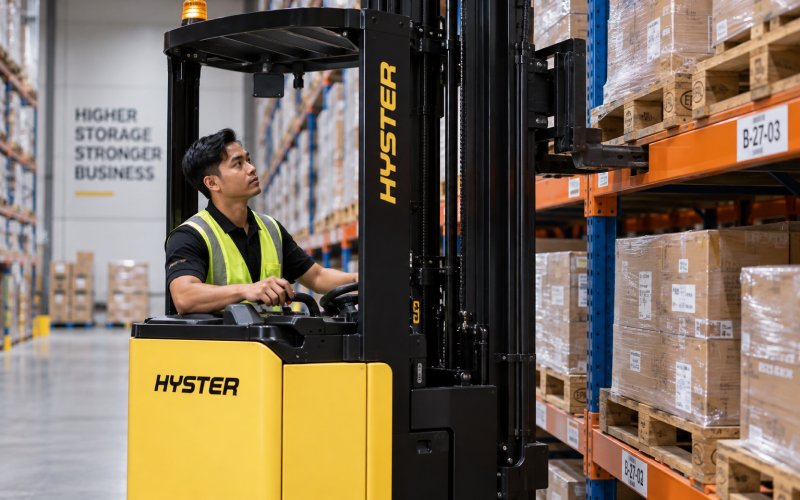
This makes choosing between a reach truck and a VNA truck an important part of planning high-density warehousing. A VNA forklift, or very narrow aisle truck, is designed for tightly configured storage aisles, while a reach truck offers more flexibility to move between different warehouse areas. Both can access pallets at height, but the way they use aisle space can lead to very different warehouse layouts.
The better fit ultimately depends on more than maximum lift height. Aisle dimensions, pallet weights, racking configuration, throughput, and travel requirements can all influence the decision.
What Is the Difference Between a Reach Truck and a VNA Truck?
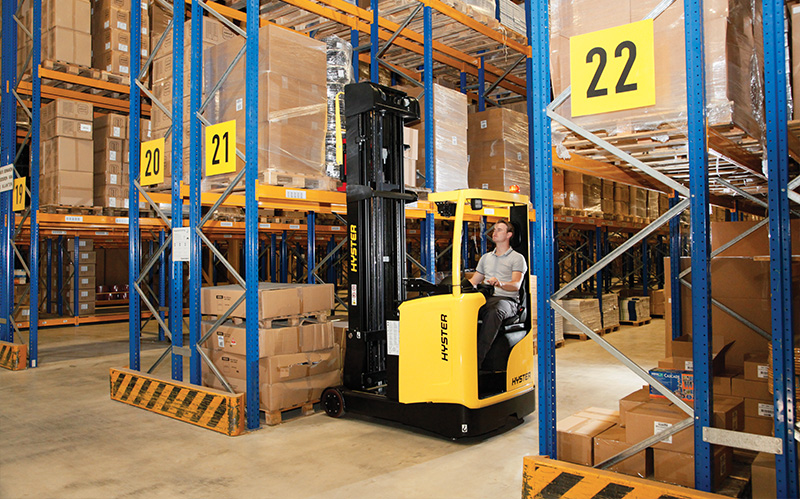
A reach truck uses a mast or fork carriage that reaches forward towards the rack. This allows the truck to position and retrieve pallets without requiring the operating space associated with many conventional counterbalance forklifts. Importantly, the truck can leave the storage aisle and travel independently to other suitable areas. This makes reach trucks useful where pallet handling extends beyond putting goods into and taking them out of racks.
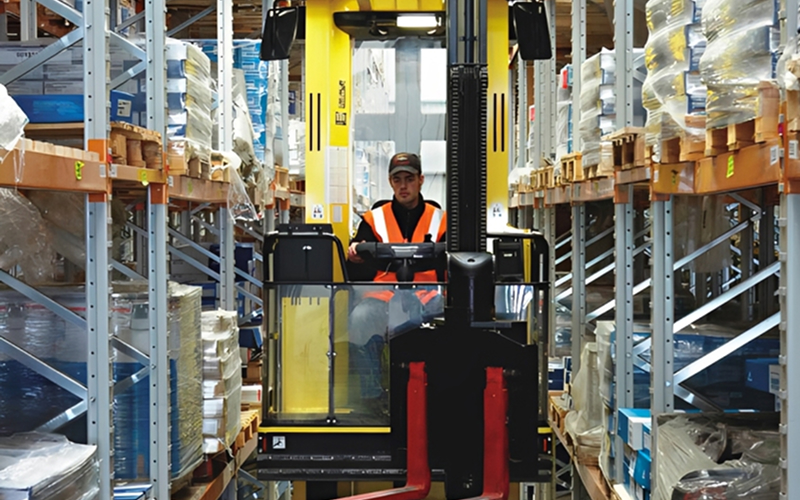
On the other hand, a VNA truck takes a more specialised approach. It operates within very narrow aisles where racks can be positioned closer together. Depending on the truck configuration, the load-handling mechanism can move towards either side of the aisle, avoiding the need to turn the entire truck towards the rack.
How Much Aisle Space Do You Have?
Aisle width is one of the first measurements to check because it quickly determines which options are practical. Reach trucks require enough room to manoeuvre and align with pallet positions. They can work effectively in a narrow aisle warehouse while still moving between aisles and other operating zones.
Meanwhile, a VNA system can reduce aisle requirements even further. As clearances become tighter, some installations use rail or wire guidance to keep the truck accurately aligned as it travels through the aisle.
This has implications beyond selecting a truck. If a business is redesigning its storage operation, it should consider the equipment and warehouse racking together. Installing racks first and then discovering that the intended truck needs more manoeuvring space can limit the storage density the project was intended to achieve.
How High Do You Need to Store Pallets?
Floor space is only one dimension of warehouse capacity. Using more of the building’s vertical space can create additional pallet positions, but the truck must still handle the required loads effectively at those heights.
Key details include:
- Maximum racking height
- Typical and maximum pallet weight
- Pallet and load dimensions
- Load centre
- Frequency of retrieval from upper levels
- Required residual capacity at height
Residual capacity deserves particular attention. A truck’s nominal capacity does not necessarily mean it can handle the same load at every lift height and load centre. For a VNA forklift or reach truck, the useful question is whether the selected configuration can handle the actual pallet safely and effectively at the highest location it needs to reach.
How Does Each Option Affect Warehouse Flexibility?
A reach truck can move between appropriate storage aisles, staging areas, and other parts of the operation. That flexibility can help when the same truck performs several pallet-handling tasks or when stock movement patterns change throughout a shift.
A VNA system is more closely integrated with its storage layout. The reduced aisle width can create additional pallet positions, but the operation may need transfer points or complementary warehouse lifting equipment to move loads between VNA aisles and other areas.
For example, a high-volume facility may use VNA trucks within dense storage aisles and another truck to move pallets from receiving to a transfer point. This setup can work efficiently when pallet movements are carefully planned, so the wider flow of goods should be assessed alongside the benefits of narrower aisles.
What About Picking Speed and Throughput?
More pallet locations do not automatically create a more productive warehouse. Goods still need to reach the right place at the required pace.
Reach trucks can be advantageous where operators frequently travel between several storage and staging areas. Their ability to leave one aisle and continue directly to another part of the warehouse can reduce the need for load transfers.
A VNA forklift can support highly structured operations where pallet locations, aisle movements, and replenishment processes are organised around dense storage. Throughput will still depend on factors such as travel distance, lift height, guidance systems, pallet turnover, and how loads enter and leave the VNA area.

Reach Truck or VNA Truck: Which Fits Your Warehouse?
A reach truck may be more appropriate when you need relatively narrow aisles but still want the truck to move freely between different warehouse areas. It can also suit operations that combine high-level storage and retrieval with flexible pallet movement.
A VNA forklift may suit businesses looking to maximise pallet positions within a structured aisle system. By reducing the space required between racks, it can make better use of the available footprint while supporting high-level storage.
Therefore, the choice should consider the complete operation: aisle width, rack height, pallet characteristics, movement frequency, transfer points, and how other industrial warehouse equipment fits into the material flow.
Match the Truck to the Storage Strategy
Reach trucks and VNA trucks can both use warehouse space more efficiently, but they achieve that outcome differently. Reach trucks balance high-level storage with greater freedom of movement, whereas VNA trucks reduce aisle space when the warehouse is designed around a more specialised storage system.
At Hyster-Yale Lift Trucks Singapore, we can assess factors such as aisle dimensions, lift height, pallet characteristics, capacity requirements, and material flow when considering suitable warehouse equipment. The goal is to identify a configuration that matches how pallets actually move through a facility.
If you are changing your racking or forklift configuration, speak with our team to discuss your equipment requirements.