0
0
The Two Types of Forklift Batteries: Which One Fits Your Operation?
Key Takeaways
- Match battery choice to your shifts, charging windows, maintenance capacity, and utilisation.
- Lead-acid suits predictable operations with enough downtime and established battery-care routines.
- Lithium-ion supports faster, flexible charging where truck availability matters.
- Compare lifetime operating impact, not purchase price alone.
Introduction
The battery in your forklift affects more than runtime. It influences work schedules, break planning, charging space, and routine maintenance. When we compare forklift battery types, we look first at how the truck is used, rather than starting with the technology itself. A warehouse running one steady shift has different needs from a distribution centre moving goods across two or three shifts.
For most businesses, the practical choice is lead-acid or lithium-ion. Both can work when matched to the application. The better question is not which chemistry is newer, but which one supports your uptime targets without creating avoidable cost, labour, or infrastructure pressure.
Lead-Acid Forklift Batteries: Pros, Cons, and Best Uses
A lead-acid forklift battery remains a familiar choice across warehouses. Its biggest attraction is lower upfront cost, especially if you already have compatible chargers, a designated charging area, and employees who know battery care. Among the main forklift battery types, lead-acid often makes sense when operating hours are predictable and overnight downtime is available.
The trade-off is maintenance. Electrolyte levels need monitoring, water may need adding at correct intervals, and the battery needs enough time to charge and cool before returning to service. That routine can be manageable in single-shift warehouses, but more demanding when every truck must stay productive longer.
Its strengths are established technology, lower investment, and suitability for moderate utilisation. The operational drawbacks are spare batteries for multiple shifts, battery-changing equipment, extra labour, and dedicated floor space. If those requirements already fit your site, lead-acid can remain a practical choice.
Lithium-Ion Forklift Batteries: Pros, Cons, and Best Uses
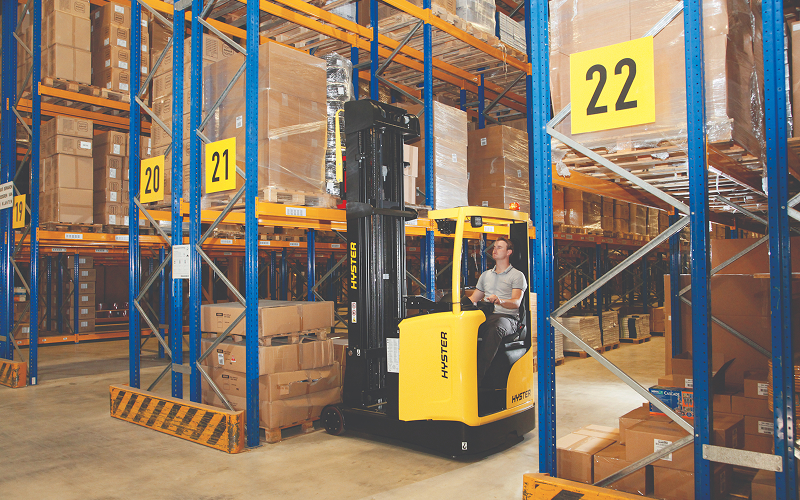
A lithium-ion forklift battery changes the operating model because it can usually be charged more quickly and topped up during pauses. That suits operations with limited downtime. Instead of organising a full battery change between shifts, your team may recharge during meal breaks, shift changes, or short idle periods.
For suitable applications, lithium-ion does not require routine watering, can reduce day-to-day battery handling, and may reduce the need for spare batteries. When we assess these forklift battery types, however, we also consider higher initial investment and whether the charger, battery, and truck are designed to work together.
Compatibility should not be left until installation. Charging equipment, electrical supply, location, and operating procedures need reviewing as one system. In Singapore, facility planning should also take relevant SCDF fire-safety requirements for battery and energy-storage installations into account where applicable. A low-utilisation truck may not gain enough from the added flexibility to justify the cost.
If you are selecting an electric forklift for a high-utilisation operation, lithium-ion can be particularly useful where charging needs to fit around short breaks rather than extended downtime.
Lead-Acid vs Lithium-Ion: Which Is Better for Your Shift Pattern?
Shift pattern is often the quickest way to narrow the decision. If your forklift completes one regular shift and sits unused overnight, a longer charging cycle may not interrupt work. Lead-acid can then support the operation comfortably.
Two- or three-shift sites face a different constraint: time. When a truck must stay available most of the day, your forklift battery charging strategy becomes increasingly important for productivity. Lithium-ion can use scheduled breaks to recover charge, while lead-acid fleets may require battery swaps, spare units, handling equipment, and people assigned to the process.
We encourage you to look at actual truck activity across the day. Record operating hours, break windows, shift overlaps, peak periods, and where trucks routinely wait. Comparing forklift battery types against those patterns shows whether faster charging solves a bottleneck or merely adds capability you rarely use.
Which Forklift Battery Is More Cost-Effective Over Time?
Upfront price can distort the comparison. Lead-acid generally costs less to acquire, but ownership can also include watering, inspections, charging time, replacement batteries, battery-changing equipment, labour, and supporting floor space. The cheapest battery on day one is not automatically the lowest-cost power solution over several years.
Lithium-ion usually requires more capital initially, yet the simpler routine can offset part of that premium in intensive applications. If opportunity charging reduces spare-battery needs or keeps trucks productive through longer shifts, the value is operational as well as financial. For a truck used only a few hours daily, those savings may never become significant.
We therefore compare total operating impact before recommending one of the forklift battery types. The same thinking applies when you are evaluating a forklift for long-term rental: utilisation, downtime, maintenance effort, and support requirements should be assessed together rather than priced separately.
What Should You Consider Before Choosing a Forklift Battery?
Start with the work your trucks actually perform. How many hours does each truck run? How many shifts do you operate? When can equipment realistically stop for charging? Do you already have chargers and electrical capacity in the right locations? Who will handle battery maintenance, and how consistently?
Fleet size adds another layer. Managing two batteries differs from coordinating dozens across busy sites. Temperature, duty cycle, application intensity, charger positioning, and available floor space can all affect the practical choice. A solution that performs well in one warehouse may be unnecessarily expensive or awkward in another.
Our approach is to treat the truck, battery, charger, and facility as one operating system. That matters when planning a broader forklift fleet strategy in Singapore because power decisions affect uptime, labour routines, infrastructure, and future equipment flexibility. The most practical choice is the setup that supports your site’s actual demands without adding unnecessary cost or complexity.
Choosing the Right Forklift Power Solution at Hyster-Yale Lift Trucks Singapore
At Hyster-Yale Lift Trucks Singapore, we can assess whether your chargers and electrical supply suit the chosen battery system, whether available charging windows can support truck availability, and whether spare batteries or battery changes are likely to be required.
Speak to our team so we can review these factors with you and identify a practical battery setup for your fleet.