0
Open vs Closed Pallet Stackers: Which One Do You Need?
Key Takeaways
- The right lifting solution depends on load weight, storage height, aisle space and rack layout, not just one specification.
- The pallet base beneath each load affects whether the machine can position itself correctly for lifting.
- Some base designs give support legs enough clearance beneath the load, while others need those legs positioned outside it.
- If your operation handles several base formats, review the full mix you use regularly rather than planning around only the most common one.
Introduction
Not every pallet stacker can handle every pallet in your operation. The issue is underneath the load, where pallet construction determines whether support legs and forks can enter correctly. If you choose by capacity and lift height alone, equipment may look suitable on paper but still fail to engage your everyday pallets.
At Hyster-Yale Lift Trucks Singapore, we see this as an application question, not simply a product choice. Open-base designs give conventional stackers more freedom to position support legs. Blocked or boarded bases can prevent that movement, changing the chassis configuration you need. Checking compatibility early can prevent a mismatch between equipment, racking and workflow.
What Is the Difference Between Open and Closed Pallets?
A pallet stacker needs space for two elements: the forks that raise the load and the structure that stabilises the truck. The underside therefore matters as much as length, width or load rating. Pallets with similar top dimensions can behave differently when approached from below.
A pallet with an open base can provide enough clearance for support legs to move into the pallet footprint while the forks engage the load. A boarded or perimeter-style base can obstruct those legs. What matters is whether the openings align with the truck’s geometry and entry direction.
A pallet with a closed base may still have fork openings, but they do not automatically provide room for a conventional fork-over chassis. Bottom boards, blocks or runners can interfere with support legs even when the forks fit. We recommend checking the physical pallet rather than relying on a catalogue description.
When Can You Use a Standard Open-Base Stacker?
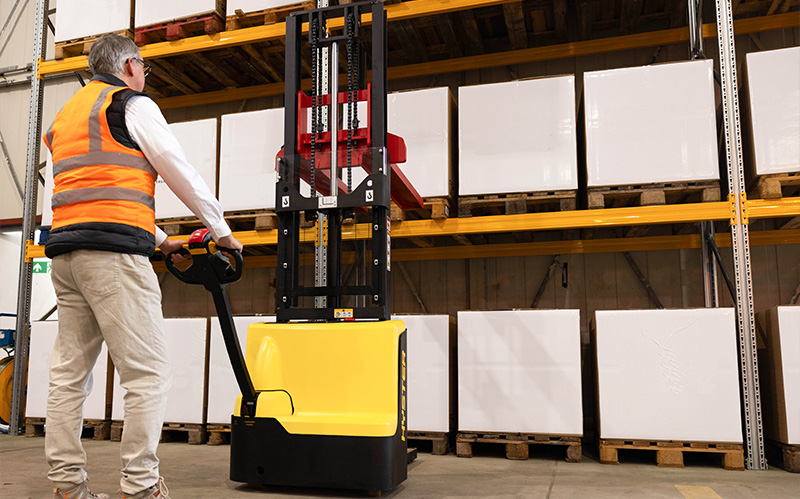
A conventional pallet stacker can be practical when your warehouse consistently uses pallets with enough underside clearance for the truck’s support legs. This suits operations where pallet specifications are controlled, loads are predictable, and goods move repeatedly between receiving, staging and racking locations.
The fit is strongest when the same compatible pallet format is used throughout. Confirm that load weight remains within rated capacity, lift height suits the model, and aisle conditions allow the truck to turn and align correctly. A compact chassis still needs room to approach the rack squarely.
It is also worth separating stacking from simple horizontal transport. Pallet trucks may be better for floor-level movement over short distances, while a stacker is selected when loads must be raised for placement or retrieval. Matching each task to the correct equipment can reduce unnecessary fleet complexity.
Where these conditions are stable, a standard configuration can keep equipment selection straightforward. This avoids specifying chassis flexibility that your operation does not need while keeping the handling method consistent. The key is to confirm that “standard” describes your actual pallet and aisle conditions, rather than assuming all warehouse pallets are interchangeable.
What Do You Need for Closed Pallets?
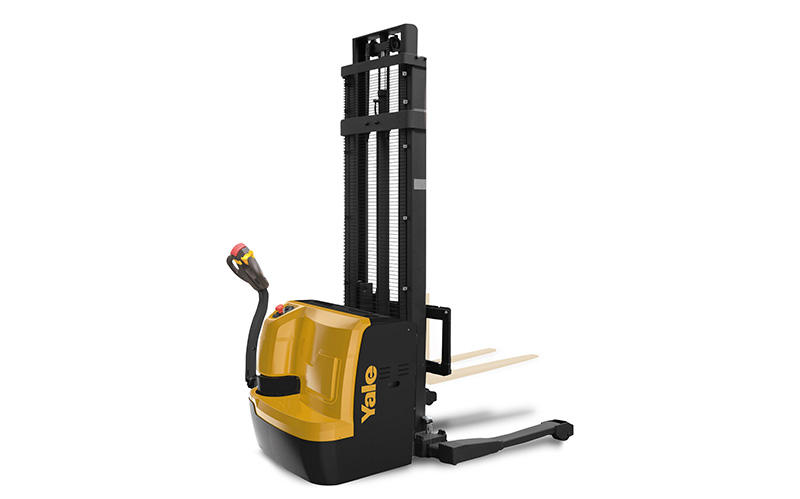
When a pallet stacker needs to handle pallets with a blocked underside, a straddle configuration is often worth assessing. Instead of sending support legs into the pallet footprint, a straddle design positions them outside the load while the forks enter beneath it. Suitable models can therefore handle pallet designs that obstruct fork-over legs.
Before choosing this arrangement, measure more than the pallet. Check width, load weight, maximum lift height, rack opening, aisle width and space beside the load. The legs need somewhere to travel. A pallet can fit between the forks yet leave too little clearance for the surrounding chassis.
This is where broader planning for material handling equipment matters. The stacker has to work with rack uprights, floor markings, staging zones, nearby traffic and the way pallets arrive from suppliers. A configuration that works at one bay may become awkward elsewhere if clearances narrow or pallet orientation changes.
Site compatibility also needs to account for how powered equipment moves through the wider warehouse. A Singapore logistics case involving a forklift highlighted the importance of proper risk assessment and traffic management. For a stacker application, that means assessing aisle clearance, rack approaches, pedestrian movement and staging areas alongside pallet compatibility, particularly where traffic flows intersect in tighter spaces.
How Do You Know Which Stacker Your Operation Needs?
Start with the pallets you receive, store and dispatch. Before specifying a pallet stacker, inspect the underside, measure dimensions, identify the heaviest routine load and record the highest storage position. Compare those requirements with the aisle space and turning room where operators must approach, lift and place loads.
If you use several pallet formats, do not design around the easiest one. An electric stacker that handles your main pallet may still become a bottleneck when imported goods, returns or supplier-specific bases enter the workflow. We would map the full mix and identify which designs are occasional exceptions and which are operationally significant.
Your assessment should also consider the warehouse lifting equipment already on site. Look at where each truck works, whether duties overlap, and whether one configuration can cover recurring tasks without compromising access or load handling. The goal is not maximum versatility at any cost, but useful flexibility where your operation needs it.
A site review should cover pallet construction, dimensions, weight, lift height, racking geometry, aisle width, floor conditions and movement frequency. We recommend checking the truck specification and capacity for the model and application rather than assuming nominal capacity applies unchanged in every situation.
Conclusion
Your next step is to assess the pallet, rack and operating space together. Hyster-Yale Lift Trucks Singapore can help you review pallet dimensions, load requirements, lift height and aisle conditions against the available stacker configurations. Speak to us to identify a configuration that fits the pallets and workflow in your operation.